
Close

837: Peter Thiel

Peter Thiel is the founder of PayPal. In 1995, he co-wrote a book with David O. Sacks where they summed up date rape as “seductions that are later regretted.” It’s called “The Diversity Myth” and is an argument against diversity and speech codes and efforts to mitigate white supremacy. He and his co-author Sacks wrote:

“But since a multicultural rape charge may indicate nothing more than belated regret, a woman might ‘realize’ that she had been ‘raped’ the next day or even many days later. Under these circumstances, it is unclear who should be held responsible. If the alcohol made both of them do it, then why should the woman’s consent be obviated any more than the man’s? Why is all blame placed on the man?”

The Diversity Myth by Peter A. Thiel and David O. Sacks

When they were criticized for their sentiments, the expressed “belated regret.”

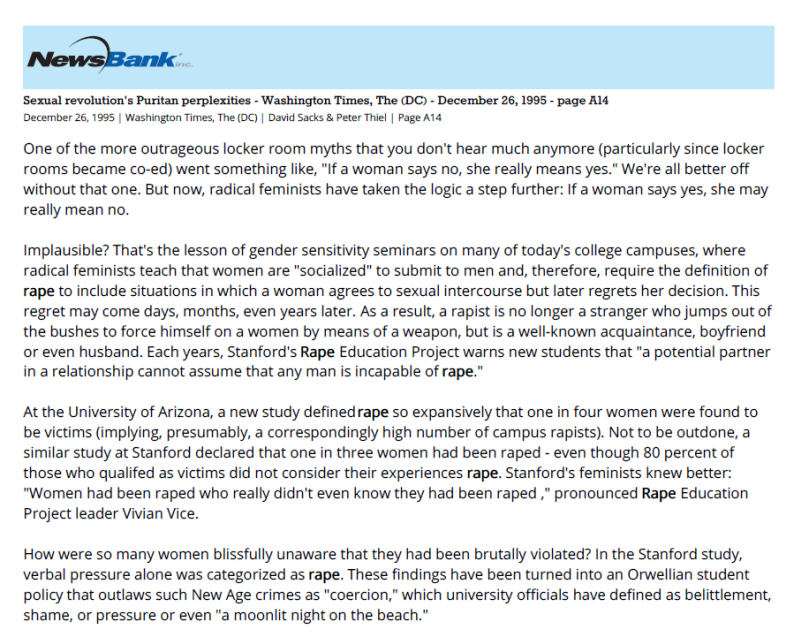
Sexual revolution's Puritan perplexities - Washington Times, The (DC) - December 26, 1995 - page A14
December 26, 1995 | Washington Times, The (DC) | David Sacks & Peter Thiel | Page A14
One of the more outrageous locker room myths that you don't hear much anymore (particularly since locker
rooms became co-ed) went something like, "If a woman says no, she really means yes." We're all better off
without that one. But now, radical feminists have taken the logic a step further: If a woman says yes, she may
really mean no.
Implausible? That's the lesson of gender sensitivity seminars on many of today's college campuses, where
radical feminists teach that women are "socialized" to submit to men and, therefore, require the definition of
rape to include situations in which a woman agrees to sexual intercourse but later regrets her decision. This
regret may come days, months, even years later. As a result, a rapist is no longer a stranger who jumps out of
the bushes to force himself on a women by means of a weapon, but is a well-known acquaintance, boyfriend
or even husband. Each years, Stanford's Rape Education Project warns new students that "a potential partner
in a relationship cannot assume that any man is incapable of rape."
At the University of Arizona, a new study defined rape so expansively that one in four women were found to
be victims (implying, presumably, a correspondingly high number of campus rapists). Not to be outdone, a
similar study at Stanford declared that one in three women had been raped - even though 80 percent of
those who qualifed as victims did not consider their experiences rape. Stanford's feminists knew better:
"Women had been raped who really didn't even know they had been raped ," pronounced Rape Education
Project leader Vivian Vice.
How were so many women blissfully unaware that they had been brutally violated? In the Stanford study,
verbal pressure alone was categorized as rape. These findings have been turned into an Orwellian student
policy that outlaws such New Age crimes as "coercion," which university officials have defined as belittlement,
shame, or pressure or even "a moonlit night on the beach."
That noise you hear is the trampling of students' rights. And don't even think of using the Constitution as a
condom, because Catharine MacKinnon and company have already poked a hole in it: When a Stanford
upperclassman recently had consensual sex with a later regretful freshman woman, he was subjected to an
inquisition by the university, which suspended him and put a hold on his graduation. Nobody ever said the
dating game was easy, but now the faux pas of failing to satisfy your partner may lead to expulsion. Not
surprisingly, all the hysteria about a "date rape" epidemic has put a serious damper on campus romance.
This is a curiously puritanical result from the same generation that gave us the sexual revolution. At Stanford,
the need for 1960s-style liberation continues to be the rationale for university sponsorship of condom
giveaways and "rubber products" parties in student dormitories, a homosexual marriage in Memorial Church,
the showing of X-rated movies at Tuesday Night Flicks, and co-ed dorm showers and bathrooms. One year,
the university distributed 9,000 condoms in two hours; it has s ince set up condom dispensing machines in
every dorm. "Abstinence is simply not a viable option, nor has it ever been," proclaimed Dean of Student
Affairs Michael Ramsey-Perez. But at the same time the university promotes the values of radical exploration
and experimentation, its conduct policy discourages more conventional gender relations.
The new puritanism sometimes manifests itself in open hostility to the dating scene. Stanford's residence
staff, for instance, has banned parties in which roommates would find one another blind dates. These parties
represented a prime social opportunity for timid dorm residents to meet other students, to mix with the
opposite sex (in short, to get a date), and to develop important social skills. Indeed, such events would seem
essential if thousands of university-subsidized condoms are no t to go to waste. But resident adviser Jerilyn
Mendoza explained that such events were baleful because they were based on heterosexual social
interaction, which is "very uncomfortable to people who are gay and aren't out of the closet."
So if some sex at Stanford is good and other sex is bad, then what makes the difference? The answer is that
gender issues are increasingly battlegrounds in today's "culture war" between radicals and traditionalists, and
sex itself has become a vehicle for the radical attack on traditional norms. Sometimes, this attack takes the
form of "liberation" - the promotion of gay marriages and of sexual exploration, for insance, or the
condemnation of traditional restraint shown by single-sex bathrooms. In other cases, such as the
manufactured rape crisis, the attack takes a puritanical form. Occasionally the new Puritanism and the sexual
revolution can be combined - such as in the banning of parties where roommates found one another dat es
(in order not to hurt the feelings of closeted homosexuals). The only common denominator that remains,
when all is said and done, is the attack itself.
Although the radical agenda is at times inconsistent, it is not random. Extreme feminism and 1960s-style
liberation are less pursuits in their own right than reflections of the same anti-Western ideology. The
underlying goal was best expressed by activists at Stanford several years ago in the form of an angry chant,
an opening shot in the culture war that is now a constant reminder of its stakes: "Hey, hey, ho, ho, Western
culture's got to go." Ever wonder why feminists declared their five gender world in Beijing?
David Sacks and Peter Thiel are the authors of "The Diversity Myth: Multiculturalism and the Politics of
Intolerance" at Stanford, published by the Independent Institute in Oakland, Calif.
Copyright 1995, 1996 The Washington Times Inc.
The Sexual Revolution’s Puritan Perplexities
Peter Thiel – Washington Times, December 26, 1995

Leave a Reply

Your email address will not be published. Required fields are marked *